ARTICLES

You are welcome to use the articles on this website. Please attribute the articles to the author and, if you wish to edit them, refer the changes to him before doing so. Notification of their use would also be appreciated. Further articles from Spiritrestoration

On the tenth anniversary of the 9/11 terrorists attacks the the French publisher, Editions Autrement in Paris, brought out a 128-page book with the title of 'Dare for peace - the audacity of the reconcilers'. It gives examples of people working to heal history and memories around the world. It begins with a section containing interviews with Mohamed Sahnoun, the Algerian founder-president of the Caux Forum for Human Security, and Corenelio Sommaruga, the Swiss former head of the International Committee of the Red Cross, at Caux. The editors are French journalists Richard Werly, Francois d'Alancon and Anne Dhoquois; the introduction to the publication, in English, is by Michael Henderson.

A new nation, South Sudan, has just been born amidst great celebration and, sadly in some quarters, predictions of failure. The world's 193rd state and Africa's 55th, one of the world's poorest, faces enormous challenges following civil wars and neglect, with nearly 40% of its population on food aid. The land-locked country is rich in oil and minerals but dependent on agriculture and desperately in need of development. As Richard Dowden, Director of the Royal African Society, wrote last week, 'If South Sudan becomes a peaceful successful state, it will be a miracle.'

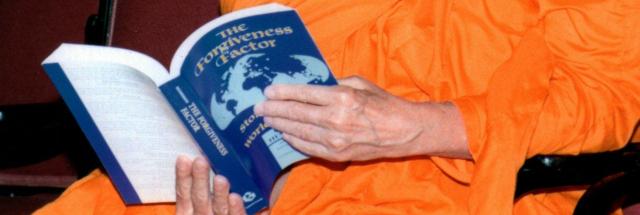
Professor Elazar Barkan, a political scientist, in his book The Guilt of Nations, has observed that there is a new international emphasis on morality which has been 'characterized not only by accusing other countries of human rights abuses but also by self-examination'. He writes of a new internationalism personified by leaders who have been ready to apologize and repent for gross historical crimes in their own countries and for policies that ignored human rights. 'Moral issues came to dominate public attention and political issues and displayed the willingness of nations to embrace their own guilt.' And, as I wrote a few months ago Professor McCall Smith looked at the same phenomenon as a philosopher and has seen the emergence of forgiveness as one of the great ideas of our new century.

It was an American clergyman who introduced me to the importance of valuing other faiths besides my own. He was ahead of his time in appreciating that you did not need to water down what you believed in order to find unity. He was never slow to share his own source of power, but as a Christian respected the way God's spirit could work through any other person.

The week of 16 May 2011 was a special one for me. Not because we inducted a new vicar in our church. That was of course special, too, as we welcomed our bishop and together lived through the solemnity of that Church of England ceremony. But that week was specially memorable to me because of the courage and perspective and grace of the head of the Church of England, our 85-year-old Queen.

I have only recently been introduced to the work of Karen Armstrong who is widely regarded as one of the best living writers on religion. Karen spent seven years as a Roman Catholic nun and then left her teaching order to study at Oxford, becoming afterwards a full time writer, authoring 16 books. She is the inspiration behind a Charter of Compassion which is gaining support around the world. 'I am a religious historian,' she says, 'and it is my study of the spiritualities of the past that has taught me all I know about compassion.'

TPM, The Philosophers' Magazine, is publishing a list of the top 50 ideas of the 21st Century submitted by leading thinkers. One on the list is Forgiveness, put forward by the writer Alexander McCall Smith who before becoming an international best-selling author was professor of medical law at the university of Edinburgh. He says that it is an idea that has come alive in the first decade of the century.

Out of the troubles in Northern Ireland have come stories of tragedy and of triumph, stories that appal and stories that inspire. The world was stirred by Gordon Wilson’s words after his daughter was killed in the horrific bombing in Enniskillen on Remembrance Day in 1987. ‘I bear no ill will,’ he said. It was an act that stirred deeper emotions than hate and revenge. Now as Catholics and Protestants learn to put the past behind them another story is emerging that deserves wider recognition.

Next month marks the centenary of the birth (20 December) of a man to whom I owe much of my journalism and my faith. He was to me the living example of the power of God to transform even the most unlikely person. He was an inspiration to thousands of young people, particularly in the United States.

It is not often that prime ministers or former prime ministers or coup leaders ask for forgiveness for their actions. Though their opponents may often call on them to apologize.